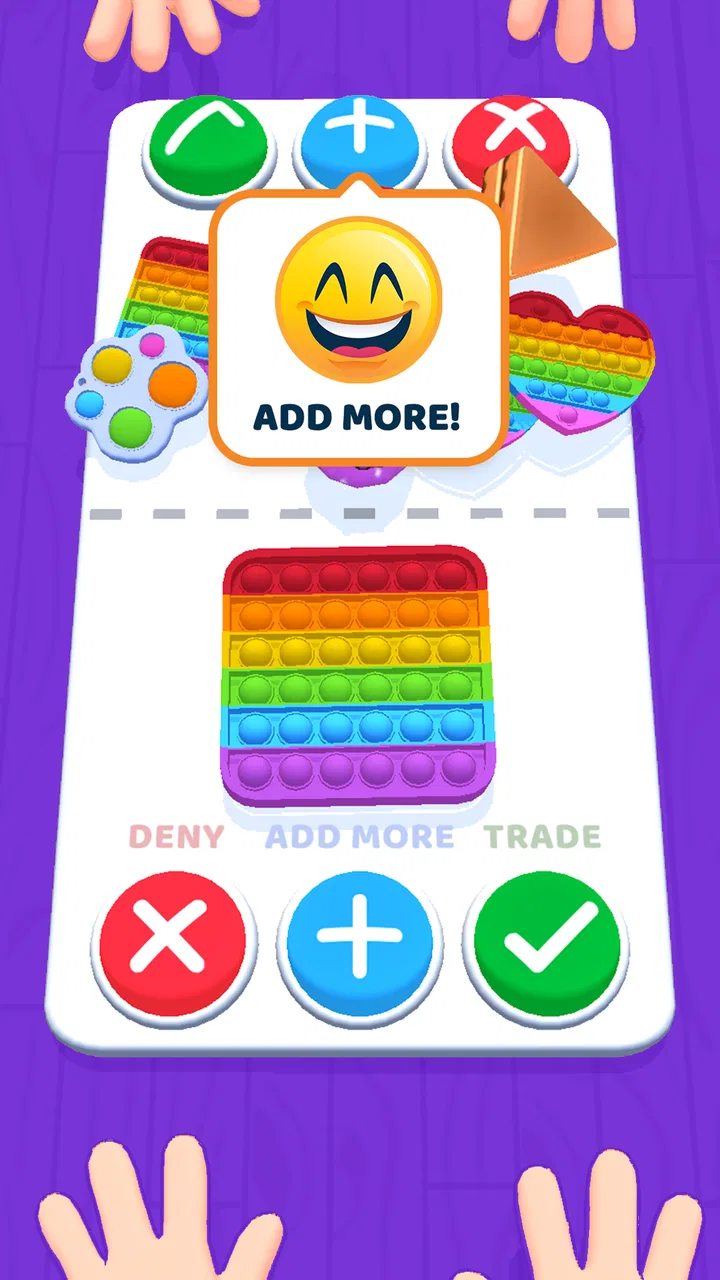
Fidget Toys Trading・Pop It 3D
- 4.7
- Rating
- 100.00M
- Installs
- Free
- Price

 Analysis by App-foxy
I spent time with Fidget Toys Trading・Pop It 3D as a casual simulation game, and my first impression was that it understands the appeal of short, tactile play. The idea is simple: interact with colorful fidget-toy-style objects, make trades, and keep moving through small moments of collection and comparison. It is not trying to be a deep business simulator or a demanding strategy game. Its strength is the quick, low-pressure loop that makes sense when I want something light rather than a serious gaming session.
That focus also explains who will enjoy it most. If you like virtual pop-it toys, simple collecting, and games that can be picked up without studying a tutorial, this is an easy recommendation to consider. If you want a detailed economy, competitive multiplayer, or long-term strategic decisions, I would set expectations lower. The game sits firmly in the relaxing, accessible side of simulation, and its best moments come from that narrow purpose.
How the pop-it trading loop feels in everyday play
The central appeal is the fidget-toy theme. Instead of asking me to manage complicated menus or learn a large set of rules, the game presents a playful trading experience built around objects that are familiar from the real-world fidget trend. That makes the opening minutes approachable, especially for younger players and anyone who prefers visual interaction over text-heavy systems.
You May Also Like

 AccuWeather: Weather Radar
AccuWeather Review: A Quick, Clear Forecast for Everyday Decisions
For everyday plans, the best forecast is the one you can understand quickly. AccuWeather makes rain timing, radar, and local conditions easy to act on, with a few trade-offs.

 Hill Climb Racing
Why Hill Climb Racing Still Turns Crashes Into One More Run
A tiny car, a bumpy hill and one more upgrade: Hill Climb Racing keeps resurfacing because its simple chaos makes every near-miss feel personal.

 AliExpress - Shopping App
AliExpress Makes Global Shopping Feel Personal, but Shoppers Bear the Risk
AliExpress turns a global marketplace into a pocket-sized discovery engine. Its reach is useful, its shopping loop compelling, and its trade-offs easy to miss.

 Lords Mobile: Kingdom Wars
Lords Mobile Is a Kingdom-Building Routine, Not a Quick Match
A case-by-case verdict on the building, battles, device demands, and social commitments that make Lords Mobile rewarding for some players and exhausting for others.

 PDF Scanner app - TapScanner
TapScanner Makes Paperwork Easier to Capture, Check, and Share
TapScanner makes scanning with a phone feel less like a rescue operation and more like a dependable step in getting work done. Its capture tools are useful, though not flawless.

 Block Blast!
 Shows How Much a Puzzle Game Can Leave Out
A quiet grid game shows why puzzle players increasingly value instant clarity, repeatable skill and low-pressure play—and where the genre still needs to catch up.
More From Our News Desk
View All News


I found it most enjoyable in short sessions. A realistic use case is waiting for a bus, taking a break between tasks, or winding down before bed. I can open it, make a few decisions, interact with the toys, and stop without feeling that I have abandoned a large campaign. That low commitment is one of its clearest advantages over simulation games that expect regular planning or lengthy sessions.
The trading theme adds a small layer of judgement beyond simply tapping objects. I naturally started comparing what I had with what was being offered, even though the experience remains intentionally simple. The useful mindset is to treat each exchange as a quick choice rather than trying to turn the game into a serious market simulator. That keeps the pace comfortable and prevents the basic loop from feeling more complicated than it really is.
The best way to approach it is as a tactile break, not as a full-scale management game. That distinction matters. Players looking for a calming toy-like experience will probably understand its appeal immediately, while players expecting detailed prices, complex supply systems, or a deep progression model may find the interactions too light.
What speed feels like during normal sessions
In ordinary use, the game is designed around quick responses from the player rather than long stretches of passive waiting. The individual actions feel compact, and the overall structure encourages me to keep making small choices. That perceived speed is important because a simple game loses much of its charm if every interaction feels like work.
I would not describe the experience as a high-intensity arcade game. Its pace is gentler, with the fidget presentation doing much of the work. The visual theme gives the actions a satisfying sense of activity without requiring reflexes or precise timing. For me, that made it suitable for relaxed play, but it also means there is less excitement for anyone who wants constant challenge.
One practical tip is to play in short bursts first instead of assuming it will become a long-session game. The trading loop is easier to judge when I focus on whether the small interactions are enjoyable on their own. If the tactile theme works for you, the modest pace feels pleasant. If you need rapid progression or a stronger sense of urgency, the same pace may feel limited.
What happens when the session becomes heavier
The most demanding moments are not necessarily difficult in a strategic sense. They come when I keep returning to the game and repeat the same style of interaction for longer than a quick break. A loop that feels relaxing at first can become predictable when extended, particularly for players who need new goals or increasingly complex decisions to stay interested.
This is where the game differs from larger simulation alternatives. A farming simulator, shop-management game, or city builder usually gives me several systems to balance, so one repetitive task can be replaced by another. Here, the fidget-toy identity remains central. That consistency is good for accessibility, but it naturally narrows the range of things I can do.
My advice is to use the game as a rotation title. I would play it when I want something easy, then switch to a deeper simulation when I feel like planning or building. Trying to force it to provide the same depth as a management game is likely to create disappointment. Its value is in the short, uncomplicated loop, not in endless complexity.
Another useful habit is to pay attention to why you opened it. If you want a few minutes of distraction, the toy-like presentation supports that goal. If you are looking for a game that rewards a long uninterrupted session, choose something with broader systems. This is a genuine trade-off rather than a flaw that can be solved through settings.
Stability, recovery, and the practical side of reliability
For a game built around small interactions, reliability means more than simply launching. I also care about whether I can return to it without having to reconstruct what I was doing, and whether a brief interruption ruins the point of the session. Its casual format is naturally forgiving: because the play pattern is compact, an interruption feels less costly than it would in a long strategy round.
I would still treat it like any mobile game and avoid assuming that every moment is disposable. When I am in the middle of a trade or another important interaction, I prefer to finish that action before switching apps or locking the screen. That is a sensible recovery habit for any game where progress depends on completing an interaction, even though I would not claim a guaranteed outcome for every interruption.
The game comes from Freeplay Inc and has built a very large audience, with more than one hundred million installs and an average rating of 4.6 from roughly 585 thousand ratings. Those figures suggest that the basic concept has broad appeal, but they do not replace personal testing. A popular casual game can still be the wrong fit if its pace or repetition does not match your preferences.
When I think about reliability here, I separate the game’s simple design from the wider conditions of mobile play. Device age, available storage, background activity, and the operating system can all affect how any app behaves. I would keep the game updated when possible and close unusually heavy apps if the phone is struggling. Those are ordinary precautions, but they matter more on older hardware.
Device constraints and who should be careful
The listed minimum operating system is Android 7.1, which makes the game accessible to a broad range of Android devices. That does not mean every compatible phone will offer the same experience. A newer phone may feel more comfortable during longer sessions, while an older device can be more sensitive to heat, low free storage, or several apps running at once.
Because the game uses a three-dimensional presentation, I would pay attention to how your phone handles other 3D games. I am not assigning a hardware requirement that is not listed, but this is a practical comparison: if your device already struggles with basic animated games, you should keep expectations modest. The minimum operating system tells me about software compatibility, not the exact smoothness every phone will provide.
It is free to play, which removes the biggest barrier to trying it. That is useful for families deciding whether a child might enjoy the concept, especially with its Everyone 10+ content rating. I would still supervise younger players according to your household rules, particularly around time spent in any game. Free access makes experimentation easy, but it does not automatically make the experience ideal for every age or attention span.
The current version is 1.31.5, so I would check that the installed build is current before judging performance on a particular device. Updates can change how an app behaves, and comparing an old installation with a current one can lead to an unfair conclusion. I also recommend leaving some breathing room in device storage rather than filling the phone completely; that is a general reliability practice that can help mobile apps recover more comfortably.
How it compares with other casual simulation choices
Compared with a traditional virtual-pet game, this title puts more emphasis on objects and trading than on caring for a character over time. That makes it a better choice when I want quick visual interaction without committing to a daily routine. A virtual pet may offer a stronger sense of attachment, while this game is more immediate and toy-focused.
Compared with a shop or tycoon simulator, the trading here feels easier to understand but less substantial. A business simulator is the better option if you enjoy setting prices, balancing resources, and watching a larger system develop. This game is better when those responsibilities sound tiring and you would rather make small choices around a playful collection.
It also differs from a pure fidget or sensory app. The trading idea gives me a reason to interact with the toys instead of simply repeating a calming motion. That extra context can make the experience more engaging, but people seeking a completely quiet, distraction-free sensory tool may prefer an app built only for that purpose.
There is a useful middle ground here: players who like the look and feel of fidget toys but still want a game structure. The compromise is that neither side becomes especially deep. The fidget presentation is the hook, and the simulation layer is intentionally approachable rather than elaborate.
Who will enjoy it, and who should skip it
I would recommend it to casual players, fans of pop-it-style toys, and people who want a game that can be understood quickly. It also suits someone who dislikes losing a large amount of progress because a session was interrupted. The light format makes it a reasonable choice for short breaks, provided the repetitive loop matches your taste.
I would be more cautious recommending it to players who need a clear long-term objective, detailed customization, competitive ranking, or a complex economy. Those expectations belong more naturally to management and strategy games. I would also skip it if the fidget theme itself does not appeal to you, because the presentation is not a minor decoration; it is the foundation of the experience.
For parents, the Everyone 10+ rating gives a useful starting point, but I would still look at how the individual player responds to repetitive mobile games. The game’s easy access can be positive for independent play, yet the same simplicity can make it tempting to continue without a natural stopping point. Short, agreed play windows work better for my household than leaving any casual game open-ended.
My performance verdict after using it
Fidget Toys Trading・Pop It 3D works best when I judge it by its intended scale. It is a free simulation game from Freeplay Inc with a fidget-toy focus, not a replacement for a full management experience. Its perceived speed is comfortable, its interactions are easy to pick up, and its compact structure makes recovery from ordinary interruptions less stressful than in a long-form game.
The main limitation is also clear: the same focused loop that makes it approachable can feel repetitive during heavy use. Device performance will depend on the phone and its condition, so the Android 7.1 minimum should be treated as a compatibility floor rather than a promise of identical smoothness everywhere. Keeping the system current, closing demanding background apps, and playing in shorter sessions are sensible ways to get the best experience.
Released on July 2, 2021, and still available as a free title, it has had plenty of time to find an audience. I can see why it has attracted such a large number of players, but popularity is not the deciding factor for me. I would install it when I want a colorful, low-pressure break built around virtual fidget toys and simple trading. I would choose another simulation game when I want meaningful planning, deeper progression, or a session that keeps unfolding for a long time.
My final recommendation is therefore specific: try it if the tactile pop-it theme sounds enjoyable and you value quick, uncomplicated play. Go in expecting a playful distraction rather than a demanding simulator, and its strengths become much easier to appreciate. For a short sensory-themed gaming break, it is a solid fit; for deep simulation, it is not the right tool.
FAQs for Fidget Toys Trading・Pop It 3D
01What is Fidget Toys Trading・Pop It 3D?
Fidget Toys Trading・Pop It 3D is a mobile game that simulates the experience of trading and collecting virtual fidget toys. Players can pop bubbles, trade toys with others, and unlock new items as they progress. The game combines elements of strategy and relaxation, making it popular among users seeking stress relief and entertainment.
02Is Fidget Toys Trading・Pop It 3D free to play?
Yes, Fidget Toys Trading・Pop It 3D is free to download and play on both Android and iOS platforms. However, it includes in-app purchases that allow players to buy additional items or speed up progression. While these purchases can enhance the experience, they are completely optional.
03What are the main features of Fidget Toys Trading・Pop It 3D?
Fidget Toys Trading・Pop It 3D features a variety of interactive fidget toys, realistic popping sounds, and a trading system that lets players exchange toys with others. The game also includes daily challenges, customizable collections, and a leaderboard to compete with friends. Its intuitive design makes it accessible to all age groups.
04Does Fidget Toys Trading・Pop It 3D require an internet connection?
An internet connection is required for certain features such as trading with other players and accessing online leaderboards. However, many aspects of the game, like playing with the fidget toys and completing daily challenges, can be enjoyed offline. This flexibility makes it convenient for users on the go.
05Is Fidget Toys Trading・Pop It 3D suitable for children?
Fidget Toys Trading・Pop It 3D is designed to be family-friendly and suitable for children. The game promotes creativity and relaxation through its interactive toy mechanics. However, parents should be aware of the in-app purchases and may want to set restrictions accordingly to prevent unintended spending.
Pros
- Engaging fidget toy simulations.
- Variety of toys to trade and collect.
- Simple
- intuitive gameplay.
- Visually appealing 3D graphics.
- Regular updates with new items.
Cons
- Can become repetitive over time.
- Contains in-app purchases.
- Ads can be intrusive.
- Limited interaction depth.
- Requires internet connection.

Fidget Toys Trading・Pop It 3D
Gallery